Balige: Every Story Leads to Marchia

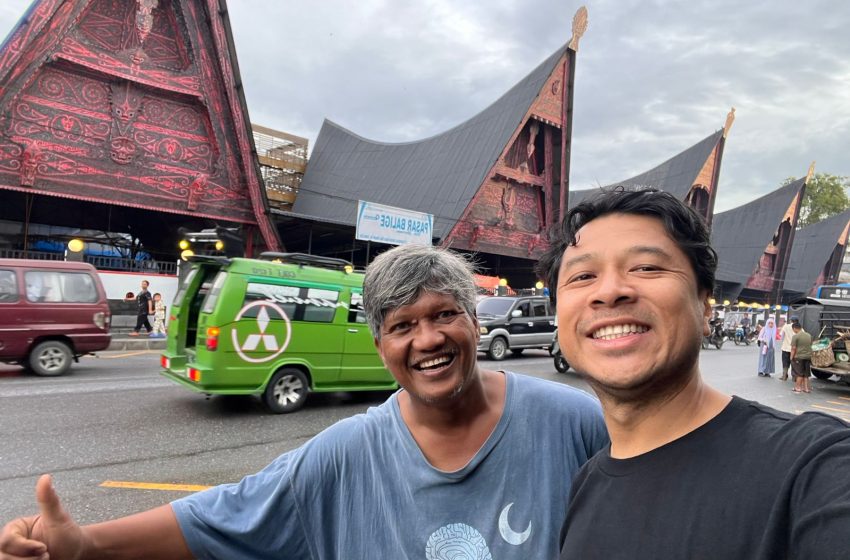
With Sebastian Hutabarat against the backdrop of the balerong row at Balige Market (May 2026)
By Benny Arnas
I have always liked markets because they are perhaps the only places where people stand emotionally undressed. Cunning, hypocrisy, and carefully curated self-images collide in the noisy theater of buying and selling. On social media, anyone can become anyone else. At the office, people perform their assigned roles. Even at home, many live behind masks of patience or authority. But in a market, life is simpler. The woman selling leppet wants nothing more than to sell every last bundle. Mothers are searching for gandong cakes while they are still warm. A pedicab driver waits for his first passenger of the morning. That is why, alongside museums, markets have always seemed to me the quickest way to understand a city. Museums tell stories about a past that has already been curated. Markets tell stories that are still unfolding.
firstly published in Indonesian by Cagak.id, 15 June 2026
Balige’s Native Tongue
Years ago, in Villach, a small town in southern Austria tucked between the Alps and icy rivers, I spent nearly an hour talking to a baker who confessed he had never lived anywhere else in more than sixty years. I had intended to buy only two pastries for breakfast. He, however, seemed far more interested in selling stories than bread.
He spoke about young people leaving, family-owned shops closing one after another, and how the town had grown wealthier while somehow feeling lonelier.
“Everything’s better now,” he said, gesturing toward spotless streets and meticulously maintained buildings.
Then he shrugged.
“But somehow… it feels emptier.”
That sentence stayed with me for years–not because it was particularly profound, but because I kept hearing echoes of it elsewhere.
In Verona, an elderly woman selling tomatoes and olives lamented much the same thing. In Sydney, a bus driver taking me toward the suburbs remarked that people nowadays seemed more occupied with chasing life than actually living it. Even in Panca Mukti, a small village in Central Bengkulu, a coffee farmer once told me that although there were more motorcycles, sturdier houses, and satellite dishes than twenty years ago, neighbors gathered far less often after the evening prayer.
It is as though modernity, wherever it lands, always arrives carrying gifts and losses in the very same box.
Perhaps that is why I find myself drawn to small towns that quietly work their way into one’s consciousness.
From the window of the car carrying me from Silangit Airport toward the shores of Lake Toba, water and mountains took turns appearing around every bend. At times the lake looked like a misplaced sea stranded in the middle of an island. At others, like a giant sheet of metal reflecting the sky. The closer we came to Balige, the more traditional Batak houses with their soaring roofs lined the roadside. Some were still inhabited. Others resembled monuments to families who had long since left them behind.
“Look at that,” Sebastian said, pointing at a lone balerong as we walked more than a kilometer from our guesthouse toward the market intersection, where the traditional house stood across the road from a monument.
“That house is magnificent,” he said, “but standing there all by itself … it feels dry.”
Before I could answer, the founder of Toba Art Gallery pointed toward the bustle of the market, some five hundred meters away. There, five balerong stood side by side.
I stopped in my tracks.
The dark-skinned man, his hair now mostly gray, was right. Together, the houses possessed something the solitary one lacked. They were no longer “dry.” They belonged to one another.
For a moment I simply stood there, wondering how God had imagined this town.
Many tourist destinations depend on a single natural wonder. Balige seems to have been blessed with two: Lake Toba on one side, rolling green hills on the other.
Yet what fascinated me most was not its landscape but the rhythm by which the town moved.
In many places, modernity arrives like a bulldozer. It flattens the past, erases old traces, and replaces them with rows of interchangeable buildings. Balige appears to have chosen a more complicated path. The past remains visible everywhere–in its old churches, in the family names that still surface naturally in conversation, in the way residents speak of their history not as something finished but as something still breathing, and, of course, in the traditional houses that continue to stand.
At the time, I did not yet realize that nostalgia was one of Balige’s native languages.
Nor did I realize that Sebastian Hutabarat was among its most eloquent speakers.
Marchia’s Story
I met the perpetually smiling man at The Boat, his lakeside homestay, which also served as the venue for the writing workshops during the Balige Writers Festival at the end of May.
The place rested quietly along the water, far enough from the crowds that the sounds of waves and wind became part of everyday life. There was no unnecessary luxury. Its charm lay precisely in its restraint. A carefully tended garden. Wooden cottages facing the distant lake. Chairs that seemed to invite people to stay longer than they had intended.
I have always liked places that never try too hard to impress.
Our conversation began with the usual topics: travel, the weather, and the festival that would soon begin. Somehow, though, it drifted toward my habit of wandering cities on foot.
“You walk to the market?” he asked, his eyes lighting up.
“Almost always.”
“Alone?”
“Usually.”
He laughed.
“And you just… talk to people you’ve never met?”
“I always hope to. It doesn’t work every time. But when it does, it’s worth it.”
He laughed even harder.
“I’ll be ready at six fifteen tomorrow morning,” he said, referring to my plan for an early walk. “Hopefully I can come along.”
He said it less like a request than a simple announcement.
I have always had a weakness for unexpected things.
Including walking companions who seem to fall from the sky.
I once read that human beings do not really live by calendars.
We live by events.
Almost no one remembers what happened on June 14 ten years ago unless something extraordinary occurred that day. What remains with us is never time itself, but what happened inside that stretch of time. That is why someone may forget the year they graduated yet still remember the color of the shirt they wore when they first fell in love. Another person may forget the date of a wedding anniversary yet vividly recall the smell of the hospital where a parent died.
Life, it seems, has an odd way of working.
It quietly erases thousands of ordinary days while allowing only a handful to refuse oblivion.
“She was our second child,” Sebastian said as we reached the seventh kilometer of our walk. “Her name was Marchia.”
By then the sun had begun climbing above the hills. Between buildings, Lake Toba flashed now and then like a sheet of silver spread beneath the morning sky. A pickup truck loaded with vegetables rattled past us. Outside a coffee stall, several men sat around a plastic table, sipping black coffee as the town slowly awakened.
But my attention remained fixed on Sebastian’s voice.
“When she was little, she wanted to become a hairstylist.”
He smiled faintly.
There was no bitterness in it, so I simply let him continue.
Like many children, Marchia grew up with dreams that kept changing shape. She became interested in the arts. She studied diligently. Teachers recognized her promise. One of them eventually encouraged her to study business after high school.
Sebastian told the story the same way he had spoken about Balige’s traditional houses and old schools–with no embellishment, no attempt to make it sound tragic.
And that was precisely when I began to feel uneasy.
Over the years, I have met many people who have lost someone they loved. Some cry while telling the story. Others cannot finish a sentence without stopping to compose themselves.
But there is another group, far harder to understand.
Those who speak with startling calm, as though their sorrow has sunk so deep that it no longer needs to announce itself.
“On June first, I drove them to Silangit Airport,” he said. “Sixteen days later, I got a phone call.”
By then I already knew where the story was heading.
Lives that are narrated with such careful chronology usually lead toward only one of two destinations: great triumph–or tragedy.
“Marchia died.”
He said it in exactly the same tone he had used moments earlier when telling me that she had been accepted to Gadjah Mada University.
That moment reminded me of the work of Elizabeth Loftus, whose research has repeatedly shown that memory is not a neatly archived video recording stored somewhere inside the brain. It is closer to a story we keep rewriting. We forget. We rearrange details. We add scenes that never happened and erase those that did. Every act of remembering is, in some sense, an act of reconstruction.
Trauma researchers, however, have discovered something curious.
When a person’s life is shattered by events involving death, catastrophe, war, or profound loss, the brain often begins to function differently. Details that would ordinarily seem trivial become indelibly etched into memory. Psychologists call these flashbulb memories–moments that appear frozen by an explosion of emotion.
People may not remember what they had for dinner last week, yet they can still recall the color of the shirt they were wearing when they learned that someone they loved had died decades earlier. They forget conversations from yesterday, but remember exactly where the chair stood, what the weather was like, or how the telephone sounded on the day their world changed.
Of course, such memories are not always accurate. Study after study has shown that people still misremember traumatic events. Yet they cling to those memories with far greater confidence than they do to ordinary ones.
It is almost as if the mind stamps certain moments with a warning:
Do not lose this.
As though preserving every detail might somehow preserve a fragment of the person who is gone.
Listening to Sebastian that morning, all those studies came rushing back to me, each volunteering its own explanation. Perhaps that was why he could still recount the sequence of events with such startling precision. Ever since that phone call, ever since the news of Marchia reached him, time had ceased to move as it once did. It had split in two.
Jacob spent years living with his longing for Joseph. Viktor Frankl lost nearly his entire family in the concentration camps. C. S. Lewis wrote A Grief Observed after the death of his wife. Abraham Lincoln buried his own son while war and politics continued demanding every waking hour.
No one truly returns unchanged after a great loss.
Like so many who have outlived someone they loved beyond measure, Sebastian seemed to preserve fragments of that day with the meticulous care of a museum curator.
For the first time, I felt that I was seeing the real city.
Balige, as it existed inside Sebastian.
Those Who Do Not Mourn the Sky
Several days later, I sat in the pantry at The Boat, waiting for breakfast.
“Pantry” was perhaps too grand a word. It was really an open wooden pavilion facing a small garden. From there, only part of the lake was visible. The wind wandered in and out whenever it pleased. On an old wooden table polished smooth by time sat a cup of coffee whose aroma seemed capable of slowing the morning itself.
Sebastian’s wife, Imelda Napitupulu, was preparing noodle soup.
“I used to be insane.”
She said it the way someone might casually mention having once lived in another city.
No drama.
No attempt to make the sentence sound important.
I needed several seconds to convince myself I had heard her correctly before remembering Sebastian’s activism against quarry mining in Samosir–an effort that eventually led to his being prosecuted on defamation charges and sent to prison.
She smiled, perhaps because she had noticed my expression.
“I thought losing Marchia would make me lose my mind all over again,” she said calmly.
“It didn’t.”
I had no idea what one was supposed to say in response to a sentence like that.
“Every morning at five, I read the Bible.”
That was all.
I suspected the wound ran unimaginably deep.
Yet, like her husband, Imelda seemed unwilling to treat sorrow as a spectacle.
Perhaps that is why my thoughts kept returning to the balerong Sebastian had called “dry.”
At first, I assumed he had been talking about architecture.
Later, I began to wonder whether he had been talking about himself.
From the outside, his life appeared intact. The homestay continued to welcome guests. The festival went on. Visitors arrived and departed. He could still laugh, tell stories for hours, and guide strangers through the town he loved.
Yet, like that solitary balerong standing proudly near the market, the loss of Marchia had left an emptiness that no outward appearance could conceal.
His story reminded me of a long-running debate in psychology about what it means to live after loss.
For much of the twentieth century, prevailing theories of grief argued that healthy mourning eventually required letting go of the dead. Emotional attachment, psychologists believed, had to be loosened so that the bereaved could reinvest themselves in the living. Freud, among others, helped shape this understanding. Grief was seen as difficult inner work with a clear destination: accept the loss and move forward.
Then, beginning in the 1990s, researchers began challenging that assumption.
Dennis Klass, Phyllis Silverman, Steven Nickman, and others discovered that many people who had lost spouses, parents, or children never truly severed their emotional connection with the dead.
The opposite often happened.
They formed what psychologists now call continuing bonds–relationships that endure even after death has drawn its final boundary.
The dead remain present, not as ghosts, but as companions woven into everyday life.
They live in prayers still whispered. In recipes still prepared. In chairs deliberately left untouched. In tiny rituals faithfully repeated years after the funeral. These findings transformed the way many psychologists think about grief. Perhaps mourning is not always about learning to let go. Perhaps it is about learning how to carry someone differently.
Some people survive by distancing themselves from memory. Many others survive precisely because memory allows them to continue living. The dead no longer occupy the world physically, yet they remain part of one’s inner conversations, daily decisions, and ultimately one’s identity.
Suddenly I understood why Sebastian had insisted on showing me Balige through stories.
He was not merely introducing me to his hometown. He was keeping someone alive.
Keeping Grief Alive
Later that morning, while the writing workshop for emerging writers was underway, I noticed Sebastian quietly slipping into the room as though he were one of the participants.
Throughout the session, I could almost see the effort it took for him not to raise his hand. One of the workshop rules was that participants were not allowed to interrupt the lecture with questions.
I found myself smiling.
Perhaps Sebastian believes what the Indonesian writer Bagus Mulyadi once said on a podcast: that writing is our finest way of preserving knowledge–including the grief that quietly keeps us alive.
A few days earlier, I had arrived in Balige hoping to discover the story of a town.
Instead, I left carrying the story of a father who walked nearly ten kilometers with a complete stranger simply so that, at the end of the journey, he could speak a single name.
The story of a mother who chooses to read the Bible every morning before dawn so that life, somehow, will continue to move forward.
The story of a family learning not to overcome loss, but to live beside it.
Since those conversations, I have found it impossible to see Balige merely as a collection of traditional Batak houses, old churches, or spectacular scenery.
Every town, I have come to believe, shelters people who are quietly guarding something from disappearing. Sometimes it is a language. Sometimes it is a tradition. Sometimes it is the memory of someone they loved. And sometimes, what they are protecting is not happiness at all, but a wound they refuse to let heal completely–because allowing it to remain tender is another way of making sure that love does not die with the one who has gone.
When I think back on Balige now, I no longer remember the lake first, nor the hills, nor even the market where this journey began. I remember a father telling his daughter’s story without theatrical sorrow. A mother who found sanity in Scripture rather than in forgetting. And a town that taught me something I had encountered before, in places scattered across the world but had never quite understood until then:
We do not truly belong to the places we visit. We belong to the stories that those places entrust to us.
And perhaps that is why we travel in the first place–not simply to see landscapes, but to borrow, however briefly, another person’s way of carrying the weight of being human.(*)
Balige–Lubuklinggau, May 2026
Indonesian version of the essay above is here.
