Reading, Watered from the Roots

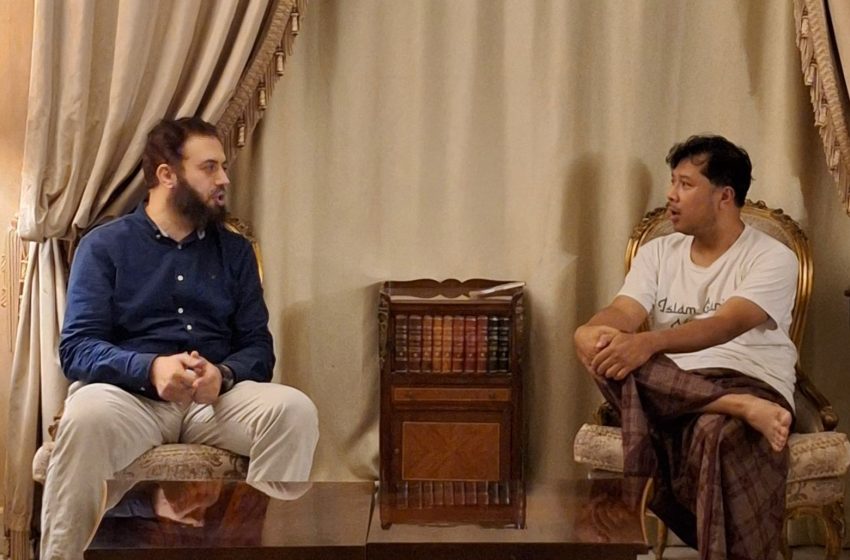
An evening of warm, casual conversation with Khalid (22 November 2025)
“In Egypt today, people do not have the luxury to read literature. Not because they dislike it, but because life is swallowing their attention.”
Khalid Mamdouh Aldarawy
By Benny Arnas
That night, on the impossibly unquiet streets of Darosah—where human shouts seemed to work in shifts and the cries of microbus drivers sounded as if sponsored by the entire chaos of the city—I sat inside a tremco filled with a mixture of gasoline fumes, sweat, street dust, and exhaust smoke that somehow slipped in through a jammed window that couldn’t be closed.
The tremco sped forward, hardly ever stopping except to drop off passengers, and because of that I knew it was impossible for the driver to respect a red light. We shot past a narrow turn in Darosah, merged into a wider road, and climbed onto an overpass. Storefront lights streaked across the windows, and the clamorous noise of the city followed us from below like an echo refusing to die.
Beside me, a young woman opened her small mushaf. Not a new one; its corners were slightly curled, its cover seemingly once wet. But the way she read it—ah, so close and steady, as though she were trying to shield its pages from the tremors of the tremco.
She seemed intent on offering a lesson in how one should set priorities. Reading included. From the moment the tremco departed Darosah until we entered the overpass heading toward Attaba, she never once lifted her head. She didn’t glance at the noise outside. She wasn’t tempted by her phone like so many others.
She simply read.
Her lips moved softly, her eyes tracing line after line of verse, as though she were chasing something more urgent than time, more necessary than entertainment, more intimate than the world.
In the midst of Cairo’s night-time uproar, she seemed to build a spiritual space all her own. And I, sitting just an arm’s length from her shoulder, felt like I was witnessing someone completing what was obligatory before allowing herself to do anything else.
When the tremco reached Attaba, she closed the mushaf, slipped a small receipt between its pages as a marker, and stepped down. No drama. No ritual. Just a simple act that, for reasons I couldn’t name, moved me more than any sermon ever had.
It felt as though someone whispered directly into my ear: “You may read anything, but finish first what strengthens your faith, your identity, and your humanity.”
That night, in the noisiest tremco I had ever boarded, her quiet presence tore open a damp wound in me as a reader: had I been fair to the books scattered around my life?
But the lesson had actually begun before that night in Darosah—exactly a week earlier, during my first days in Egypt.
At the time, I was staying at an Airbnb in Hay Sadis. My host, Khalid, a 44-year-old civil engineer with a gentle face, thin glasses, and a soft Egyptian accent, invited me to sit in his living room. No tea. No coffee. Just a dim yellow lamp, evening air drifting in through a small window, and a conversation I never expected would unsettle the way I viewed literacy.
We spoke about many things, but somehow the conversation drifted toward reading.
Khalid let out a short sigh.
“In Egypt today, people do not have the luxury to read literature,” he said. “Not because they dislike it, but because life is swallowing their attention.”
He looked at me as if to make sure I heard not just his words, but the layers beneath them.
“We read the price of bread. We read the rise and fall of the pound. We read job prospects. We read how to make sure our families can eat until the end of the month.”
He wasn’t belittling literature. He wasn’t rejecting fiction. He was mapping reality.
“You, who come from a more stable country, a life more spacious,” he continued, “must understand that reading has a scale of priorities. Some readings are pleasant; some readings build you. And when life narrows, you must open a channel so the air can come in. And that, of course, is not imaginative reading.”
His words struck me—not harshly, but precisely. Reading, it turned out, wasn’t merely a mirror of freedom. It was a freedom that demanded responsibility. Yes, those who stand in bread lines do not begin their day with poetry. They read ways to survive.
That following night, I began noticing small things I had never before read as messages.
I noticed how many taxis in Cairo played murotal instead of music. Even bus and didi drivers with jammed doors tended to choose Quranic recitations over pop songs. On city buses, I heard Surah Yasin playing softly near the driver’s seat. In a few cheap cafés, small speakers atop drink fridges recited short verses or daily prayers.
Not because they were anti-music. Not because the city was formally religious. But because every day they were looking for something to hold on to. In economic exhaustion, in suffocating inflation, in bleak politics, they chose sounds that fortified faith, not merely entertained.
The murotal was not just sound.
It was a sign that their reading priorities were clear.
That reading—whether with the eyes or the ears—served to strengthen the most essential part of themselves.
And I began to understand what Khalid meant:
In a life that constricts, humans learn to read what keeps them alive.
When my memory of Khalid merged with the sight of the girl in the tremco, they fused into a single understanding: readings are not equal. Some are obligatory. Some important. Some useful. Some merely entertaining.
Meaning, reading is not just about adding knowledge—but arranging what we consider central in our lives.
For a Muslim, reading the Qur’an is not merely worship; it is structure. It is foundation.
For a student, reading textbooks is a priority, not a distraction—because that is the road they are building.
For a storyteller, reading public-speaking techniques, narrative theory, and the art of storytelling is part of professional identity.
Each has its place. And each must be settled before anyone is free to dance into other readings.
As an East African proverb goes:
A river that forgets its source will dry.
So too will a reader who forgets their foundational texts.
That night in Darosah, and the conversation with Khalid a week earlier, became two poles realigning the space inside my mind: reading is an open activity, but the choices must be deliberate.
We may love novels.
We may enjoy poetry.
We may follow light essays.
But all of that is a bonus after we finish the readings that build our faith, our identity, our profession, and the integrity of our inner selves.
Because reading anything before tending to the essential will make us rich in information yet poor in direction.
And on the loudest night in Cairo, as the tremco carried me across the overpass toward Attaba, a girl reading her mushaf beside me taught a lesson I cannot forget:
In Cairo, reading priorities declare themselves so naturally. Murotal in taxis and buses, the soft tilawah from Darosah’s cafés, the girl in the tremco stepping off at Attaba—all seemed to say that before humans chase other forms of knowledge, there is one reading they must honor first. The city may be loud, life may be heavy, but that grounding remains guarded.
Yes, reading is no longer about how many books we devour, but about the courage to choose what must come first. Some readings strengthen the self; others widen the world. And knowledge is so vast, while time is so limited, that the two must not,
cannot,
and must never,
be confused.(*)
Darosah, 27 November 2025
