Home, Unfinished

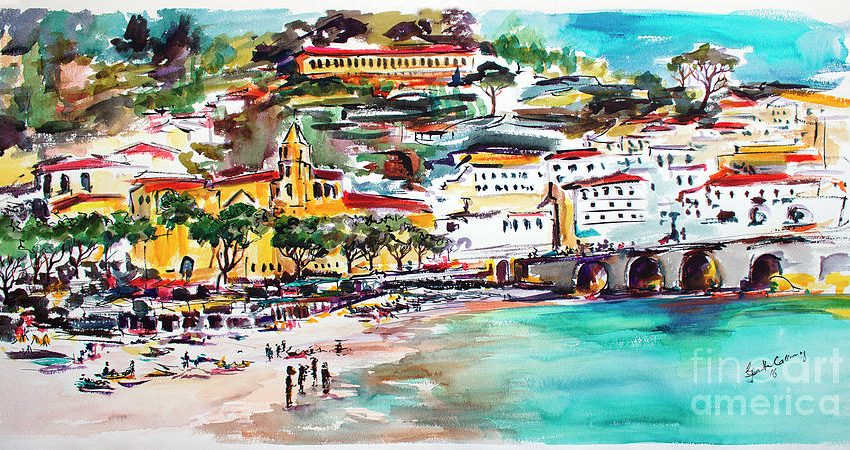
Source:https://ginette-callaway.pixels.com/featured/modern-amalfi-watercolor-and-ink-painting-ginette-callaway.html
Oleh Benny Arnas
Six years ago, I arrived in Zagreb carrying a single suitcase and a single name: Fitra Muhammad. That flamboyant man had never truly disappeared from our family; people had simply stopped mentioning him whenever conversations drifted toward 1965. At home, everyone preferred to remember him as a mathematics lecturer who never made it back rather than as a man who chose to spend the rest of his life abroad. Yet there was another name, even more unfamiliar. Rosa María Albaladejo Ferrer. Her name surfaced only in whispers, as though speaking it aloud might somehow wound Maimunah, the woman who had waited for Fitra for the rest of her life.
In the archives of the University of Zagreb, an elderly woman greeted me without saying much. Her hair had turned completely white, yet she still moved with surprising lightness. Before pulling several worn folders from a steel shelf, she handed me a pair of cotton gloves.
“So you really are looking for him?”
She repeated the name once more before disappearing into one of the archive aisles. When she returned, she carried a thin folder whose edges had begun to fray.
“There isn’t much left on Muhammad.”
I opened it. A student ID card. Course records. Grades. Then an old library card, yellowed with age. My grandfather’s name was still written there in fading blue ink. The date of the last loan read: February 1965. After that, nothing.
“Did he finish his studies?” I asked.
The old woman shook her head.
“Many foreign students disappeared during those years. Some never came back to collect their files.”
She said it flatly, as though she were explaining a change in the university curriculum. Yet to me, that single sentence weighed more heavily than everything else inside the folder I was holding.
That night, back in my hotel room, I opened Fitra’s journal, which had remained in our family’s possession for decades without anyone ever truly reading it. The opening pages were filled with equations and mathematical proofs. Between them were only brief notes about the weather, lecture schedules, and the price of bread. It was not until the seventeenth page that I finally found the name I had been searching for. My grandfather’s handwriting loosened noticeably as he wrote it.
“Today I met Rosa. She is the only person who believes mathematics is more honest than politics.”
There was no further explanation.
I tried to imagine their first meeting.
Winter had not yet released the city. A small café near the faculty building was crowded with students escaping the snow. Fitra arrived last. Every table was occupied except for a single empty chair opposite a young woman with shoulder-length black curls. Her skin was pale, her nose finely sculpted. She wore a grey wool coat far too large for her slight frame.
“May I?” Fitra asked.
The young woman nodded without lifting her head. Her pencil continued moving across a notebook crowded with mathematical symbols.
“Are you taking Functional Analysis too?” Fitra asked after the waiter had placed a cup of coffee on the table.
Only then did Rosa look up. Her eyes were light brown, sharp without being intimidating.
“I’m taking the professor,” she replied.
Their laughter broke out almost at once, warming the air between them.
From that day on they met often. Sometimes in the library, sometimes at the same café. Rosa always carried books overflowing with notes. Fitra brought neatly organised papers inside a brown folder. He rarely spoke, while Rosa almost always started the conversation.
“My father hides books beneath the floorboards,” she said one afternoon.
“Why?”
“Because some people are more afraid of books than they are of guns.”
Fitra fell silent. He had no idea how to respond. In Indonesia, books had never been regarded that way. At least, that was what he believed then.
Rosa was not beautiful in the way people usually agreed upon. Her features were too angular, her jaw too firm, her eyebrows too thick. Yet whenever she spoke, especially about her hometown, her whole face came alive. Barcelona revealed itself in the movement of her hands, in the way she spoke of the sea, its narrow streets, and the Catalan language, which she claimed felt more like home than Spanish ever could.
Fitra listened more than he talked. Perhaps that was why Rosa felt so comfortable around him. In front of the young man from Musi Rawas, she never had to explain how someone could love a homeland without always agreeing with the nation that claimed it.
Letters from Muara Beliti continued to arrive every month. Maimunah’s handwriting was always neat. Nearly every letter began with news about the rice fields and their child before ending with the same question:
“When are you coming home?”
At first, Fitra answered every letter. Gradually his replies grew shorter. Two pages became one. One page became only a few paragraphs. Eventually, some of the letters remained folded inside the drawer of his desk.
One evening Rosa noticed the growing stack of envelopes.
“Your wife?”
Fitra nodded.
“Why don’t you answer them?”
He remained silent.
Rosa gathered the envelopes into a neat pile before placing them back where she had found them. That night they continued sitting side by side in the library, yet neither of them said another word.
In his journal, Fitra wrote a single sentence that made me close the notebook for quite some time.
“I love Maimunah and our child. But in this city, Rosa makes me forget that time keeps moving.”
I stared out the hotel window. Fine snow drifted quietly outside. For the first time, I imagined Maimunah not as the grandmother I had known, but as a young woman waiting every month for a reply from a man who was slowly drifting away, not because he had stopped loving her, but because life itself was carrying him somewhere else.
My journey eventually led me to the address I had found tucked into the final page of the journal. Rosa’s house, now occupied by her grandson Arnau, stood in Sant Andreu, on a narrow street lined with small balconies and flowerpots drying under the summer sun.
The door was opened by a man about my age. He was taller than I was. Broad-shouldered, yet unhurried in every movement. His black hair had grown long enough to brush the nape of his neck. His face reminded me of an older Keanu Reeves, only paler and leaner. There was a gentleness in his eyes, as though he had spent his life listening to stories that never reached an ending.
“You’re from Indonesia?”
Arnau’s hand was cool when we shook hands. I followed him inside. In the glass of a sideboard near the entrance, I caught a fleeting glimpse of my own reflection: an Asian man of forty-two, medium-built, brown-skinned, his hair beginning to thin at the temples, his face looking older than his years after spending a week travelling from one city to another in search of a man I had never even met.
The house was filled with books. Shelves stretched almost to the ceiling. On the writing desk stood an old typewriter, a handful of pencils worn down to stubs, and a cup of coffee left half-finished. Nothing about the house suggested abandonment. It felt as though Rosa had only stepped outside for a moment.
“My grandmother passed away three years ago,” Arnau said, as though reading my thoughts. “We haven’t changed much since then.” He disappeared for a few minutes before returning with a cardboard box whose corners had been reinforced with old brown packing tape. “She kept these until the very end.”
I ran my hand across the lid of the box, not daring to open it.
“Did she ever say why?”
Arnau nodded.
“She said these never belonged to our family. One day, someone would come to take them.”
We sat facing each other. Arnau brewed coffee without the slightest hurry. The way he poured the hot water reminded me of people who believe that certain things should never be rushed.
“Did your grandmother often talk about Indonesia?” I asked.
“Often.”
“About Fitra?”
Arnau shook his head.
“About Maimunah.”
I looked at him for a long moment.
“When I was a child, I didn’t understand,” he continued. “I thought Maimunah was one of our relatives. It wasn’t until I was older that I realized my grandmother had been trying to understand a woman she had never met.”
I opened the first journal. Between equations and lecture notes, Fitra had written a single sentence.
“I dreamed of going home. Maimunah opened the door, but the man standing before her was no longer me.”
My hands stopped turning the pages.
Arnau stood, took a photograph from the bookshelf, and handed it to me.
Rosa was old. Wrinkles covered her face. Beside her stood Fitra, far thinner than he had been in the photographs from Zagreb. His hair had turned white. His smile was barely there. Behind them stretched an endless blue sea.
“Did they often go to the beach?” I asked.
“Every year on Grandfather’s birthday.”
“Why?”
Arnau shrugged.
“Grandmother used to say the sea made him feel closer to home.”
Yet the home she meant was never Barcelona.
Silence settled over us once more.
The silence inside the house was never awkward. It was there that I finally began to understand how Rosa had managed to spend decades beside a man whose heart had never truly left Indonesia.
“Did your grandmother ever regret it?” I asked.
Arnau smiled faintly.
“Never.”
“Then why did she keep these journals?”
He looked out through the open window.
“Because she knew there was a part of Grandfather’s life that would never belong to her.”
I waited.
“That part was named Maimunah.”
He spoke the sentence without bitterness.
After a brief pause, he added,
“Then she would say, ‘No Maimunah in Barcelona. That’s why Fitra never truly lived here.'”
I lowered my head. Suddenly the title, which had always sounded like little more than a play on words, revealed itself as the most honest confession of a woman who had spent her entire life sharing the man she loved with the shadow of another woman.
Before I left, Arnau walked me to the front door. He did not offer to keep some of the journals. Nor did he ask for copies. He handed me the entire box as though he had intended all along to let it go.
“I hope you find what you’ve been looking for,” he said.
I nodded.
“I think I already have.”
On the narrow streets of Sant Andreu, life went on as usual. A child pedalled past on a bicycle. An elderly woman watered the flowers on her balcony. Barcelona had not changed simply because I had finally uncovered my grandfather’s story.
What had changed was the way I saw Maimunah.
All those years I had believed Rosa was the woman who took Fitra away from his family. The truth was different. She had simply accompanied a man who never found his way home. His body may have lived beside her, but his thoughts, and the burden of his guilt, had remained in Muara Beliti.
I held the box of journals a little tighter. For the first time since beginning this journey, I was no longer searching for Rosa.(*)
Lubuklinggau, 9 July 2026
The longer version of the story above is here.
