An Island of Open Doors

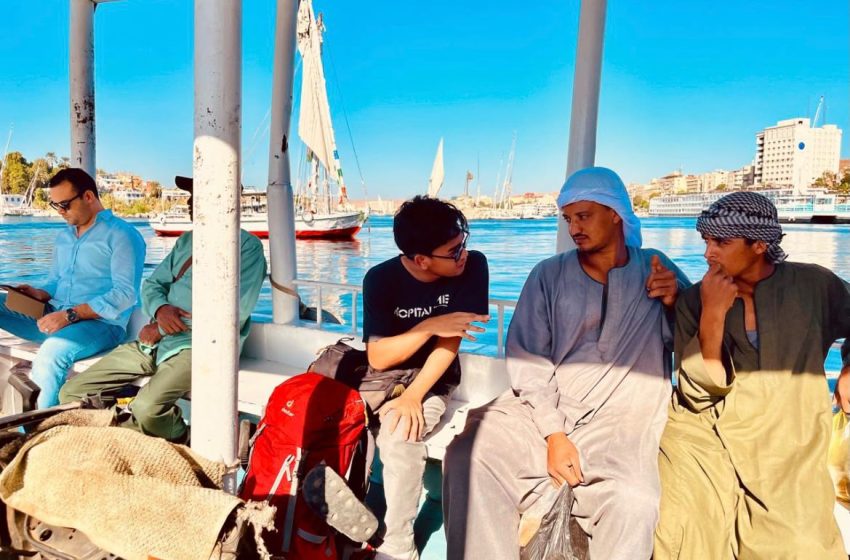
Alif (in a black T-shirt) chatting with Nubian locals aboard the boat that would take us to Elephantine Island (Source: Personal Collection)
A home is not always a place. Sometimes, it is the people who remember you.
By BENNY ARNAS
Egyptians have many ways of referring to the south. One of them is al-Sa‘id, the name for Upper Egypt, which geographically lies in the south. I have always liked such oddities: the river flows north, yet anyone heading south is travelling upstream. Here, the map begins to correct the way we are accustomed to seeing the world. The farther south one goes, the more gradually Egypt reveals a different face.
Aswan is one of its gateways. This time, I am making my way to Elephantine Island, an island in the middle of the Nile and home to one of the Nubian communities. The name Elephantine sounds like the remnant of an ancient conversation between humans and elephants. Its history is long, but I have come for something much simpler: to spend a few days there, walking, eating, reading, and watching life unfold on an island surrounded by a river.
The White Boat to Elephantine
We left Cairo after Isha, once the literary talk at the Aceh Writing Community in Hay Al-Taseah had come to an end. Alif had brought along Jack London’s The Call of the Wild. At times, the book managed to drown out the noise of the carriage, though it could not always drown out the irritation of the twenty-three-year-old whenever the train stopped for too long. His thick-framed glasses would occasionally slip down his nose as he read. He had broad shoulders and a lean body, his muscles taut and defined. His endearing face often made his complaints sound less convincing than they might otherwise have been.
There was something about the book this young man from Al-Azhar had brought on our journey south that caught my attention. The Call of the Wild tells the story of Buck, a domesticated dog stolen from his comfortable home in California, sold to pull a sled, and forced to adapt to the harsh wilderness of the Yukon.
I did not know whether Alif was reading the novel with any thoughts as far-reaching as that. More often, he complained about the noisy train and its lengthy stops. Yet the novel quietly planted a question in my mind for this journey: what happens when someone is separated from the place they come from? Does that place remain in their memory, even when they have to build a life somewhere else?
A journey we had expected to be much shorter eventually took around sixteen hours. The train seemed to have a complicated relationship with its timetable. It stopped, started moving again, then stopped for quite a while at places I could not always identify. Date palms lined the tracks. Sugar-cane fields appeared and disappeared. Here and there, farmers sat atop carts piled with produce, pulled by donkeys. The scenery kept changing: modest houses, fields, and the banks of the Nile. I repeatedly raised my phone to take pictures, although some views passed by faster than my camera could capture them.
“It would be wonderful to cycle, run, or simply walk along the little village roads we’re passing,” Alif remarked for what must have been the umpteenth time.
Once we arrived in Aswan, we had to cross by boat to reach Elephantine. The fare was fifteen Egyptian pounds, or roughly five thousand rupiah. The ferries at the landing were mostly white, with green trim along their lower hulls. Old tyres hung from their sides as bumpers for when they came alongside the jetty. The passenger area was sheltered by a roof held up by poles.
The boat we boarded had backless benches running along its sides. The Nile water looked clear, with a greenish hue. From the boat, I could see other vessels moving across the river, some carrying residents returning from the Aswan mainland. A few passengers seemed to know one another. They exchanged a few words, then went back to their own affairs: reciting the Qur’an, reading messages on their phones, or getting ready to disembark because the boat would be docking in five minutes.
The wall along the landing was painted a striking blue. It made the crossing feel like stepping onto a small stage in the middle of the Nile.
Elephantine holds a history far older than the settlement that fills the island today. Traces of habitation there can be dated to around 3300 BC. Its strategic position on the Nile, close to trade routes and the passage between Egypt and Nubia, made it an important place. The island has witnessed the passage of eras, rulers, and generations of everyday life. The name Elephantine brings elephants to mind, although I did not come across a single one. What I found instead was everyday life on a small scale: ferries, shops selling household necessities, narrow alleyways, and people who never seemed to be very far from their neighbours.
Our accommodation was a three-storey apartment owned by a Nubian man named Mahmud. It stood on the island, and from there we could walk through the residential lanes. The houses stood close together. Orange, blue, and yellow appeared on their walls. Some had small courtyards. Children played in the alleys. Men sat outside their homes or shops, occasionally greeting passers-by.
I also noticed the open doors. Some houses did not seem to have the habit of being locked during the day. The door to our accommodation was often left open, too. I came across the same scene again and again as I wandered around. Men in galabeyas walked through the lanes. Conversations drifted from behind doorways. I did not know anyone yet, but I was beginning to feel that the island would be easier to understand on foot than through a guidebook.
To be honest, the physical appearance of the Nubians, so markedly different from that of people in Cairo and Alexandria, caught my attention at once. Their skin was dark, some of it appearing almost black beneath the Aswan sun. This became a striking part of the island’s landscape, especially when men in galabeyas walked along the lanes or sat talking outside shops. Their faces belonged to every age: children, young men, and older people whose steps had begun to slow.
Yet Nubian life cannot be separated from a history of displacement. The construction of the Aswan High Dam in the 1960s led to the creation of Lake Nasser and submerged many Nubian settlements. Tens of thousands of Egyptian Nubians had to leave their homes and were relocated elsewhere. For them, this was surely more than a change of address. There were houses, land, gardens, family graves, and landscapes that had been part of their lives for generations.
Water can swallow a village, but it cannot simply erase the memories of those who once lived there.
At this point, I found myself thinking again of Buck in the novel Alif had brought along. Of course, the experience of a dog in Jack London’s story cannot be equated with the history of a people being displaced. But both made me think about the bond between living beings and the places they come from. Buck had to begin a new life after being torn from the environment he knew. The Nubian community faced a far more complex history: they had to rebuild their lives after losing the place where their traditions and memories had taken root.
Hesham, Mango Juice, and Twenty Repetitions
That afternoon, I went out for some air by the Nile. Not far from where we were staying, about fifty metres from Mahmud’s home, there was a house with an open side facing the river. “Assalamu alaikum,” I called from a distance to a husband and wife, whom I guessed to be in their fifties, sitting at ease. “Fi ruz henak, ya am?” I was hoping to find some rice at their shop.
The tall man, who used a cane, returned my greeting, also calling out, then beckoned me over with a wave of his hand. At the semi-permanent house, which doubled as a fruit and vegetable shop, I eventually learned that his name was Hesham. His wife, whose smile came easily, invited me to join her in the family sitting room. From there, we could watch boats pass, their sails fluttering in the breeze.
Hesham’s wife then served me a glass of mango juice. I had been about to refuse, but the orange colour of the juice in the large glass suddenly made me thirsty. Besides, she used one word that left me with no reason to decline. “Balash.” It was free. Masha Allah!
Although my Arabic was limited and their English did not help much either, Hesham kept the conversation going, occasionally teaching me how to say a word or sentence in the Egyptian dialect whenever he understood what I meant. We relied on words we both knew, hand gestures, and repetition. It turned out that the sense of closeness we shared as fellow Muslims could always help us feel (yes, feel!) what each attempt at communication meant. At the very least, we always ended up laughing whenever we found ourselves tangled in confusion ….
Hesham told me that the Nubians on the island all knew one another. They were all family, or so I understood him to mean as dusk approached. I remembered his words, although at the time I did not fully understand how they played out in everyday life.
The answer began to emerge as I walked more often through Elephantine’s lanes. People greeted one another. Men sat outside shops. Children ran between houses. Doors remained open. At Hesham’s shop, customers came and went without much ceremony.
Once, I saw Hesham watching a religious sermon on television when a customer arrived. He did not hurry to his feet. He simply called out the price of the vegetables or fruit the customer had asked about. The customer took a bag, chose the goods, weighed them, and paid. Hesham carried on watching or talking. He did not keep an eye on the customer’s hands, nor did he bother to check each transaction. I saw this more than once.
Around our accommodation, the mosque and the school stood within the same compound. I began to notice this arrangement after walking around the neighbourhood several times. The mosque near our apartment became one of the places I visited most often.
The imam was a relative of Hesham. There was one feature of the prayer that caught my attention and that I will surely remember. The bowing and prostration lasted much longer than the sitting position during the first tashahhud. At an ordinary recitation pace, I could repeat Subhana rabbiyal a‘la wa bihamdih as many as twenty times before the imam finally lifted his head from the prayer mat. I found myself comparing the duration with that of the first tashahhud. The difference was striking. The first tashahhud seemed brief, while the bowing and prostration appeared to have been given a generous amount of time. The congregation followed the imam calmly. I now understood why so many Nubian men had dark marks on their foreheads.
I thought of Mahmoud Darwish, the Palestinian poet who wrote extensively about homeland, exile, and memory. Darwish himself had experienced life as someone uprooted from his birthplace. In his poetry, the homeland often survives through seemingly simple things: place names, houses, language, food, and landscapes carried in memory. But I was not, of course, equating Palestinian history with Nubian history. Each has its own circumstances and experience. Still, both made me reconsider Hesham’s remark that the people on the island knew one another and regarded one another as family. Against the backdrop of displacement, such bonds seemed important.
Perhaps family and community are among the ways people preserve a sense of belonging when history has altered the place they call home.
Gargadih, a Meal Before Maghrib, and Tea Afterwards
On our last day, Alif and I walked to a café at the northern end of the island. It was more upscale than the little shops we usually came across in the alleys. We ordered gargadih, a refreshing sweet-and-sour drink made from hibiscus flowers. As we watched sailboats cross the Nile, I read Three Ancient Novels by Naguib Mahfouz, while Alif was still making his way through The Call of the Wild.
Alif grumbled a little when he saw the price: four euros for a glass of gargadih. I could not blame him. We could have enjoyed the drink at any time in our apartment, after all. Rehab, a woman in her thirties who helped out there, would make it and keep it in the refrigerator. We could help ourselves whenever we liked. “Balash,” she had said, explaining that the drink was part of the service provided by Mahmud’s apartment.
That afternoon, after Asr, Hesham and his wife invited us to share a traditional Nubian meal. I do not want to make up the names or ingredients of dishes I cannot remember precisely. What I do remember is how often Hesham and his wife made sure we ate. Conversation unfolded between mouthfuls. Several times I searched for the right Arabic word, repeated a sentence, or used hand gestures to make myself understood.
Maghrib arrived. Hesham prepared to go to the mosque, his cane helping him along. We joined the prayer, led by the man who, Hesham had told us, was a relative of his. Once again, I found myself following the imam through those long bows and prostrations.
Apparently, the hospitality was not over. After the prayer, Hesham’s wife served us shay bil-na‘na‘ and dried dates. Small glasses were placed on the table. The scent of mint rose as the tea was poured. We sat together again, talking as we enjoyed the refreshments.
Before parting, we shook hands, embraced, and exchanged WhatsApp numbers. We thanked them repeatedly. They replied with smiles and greetings. Hesham stood with the help of his cane. I still remember his tall, slender frame and his slow steps as he accompanied us to the door.
Those words now had many faces: the customer who helped himself to goods in the shop, Hesham’s wife offering mango juice and saying balash, the invitation to eat before Maghrib, mint tea after the prayer, and a handshake that seemed difficult to let go of.
Ah, I found myself thinking again of my first conversation with Hesham, when he said that the Nubians on the island all knew one another and regarded one another as family.
Those words now had many faces: the customer who helped himself to goods in the shop, Hesham’s wife offering mango juice and saying balash, the invitation to eat before Maghrib, mint tea after the prayer, and a handshake that seemed difficult to let go of.
When it was time to leave Elephantine, we crossed back on the white boat. Fifteen Egyptian pounds. Backless seats. A breeze coming off the Nile. The island slowly receded. The brightly coloured houses grew smaller, while other boats continued moving between the island and the mainland.(*)
Cairo, November 17, 2026
