Myeongdong: A Bright Day Is Everything

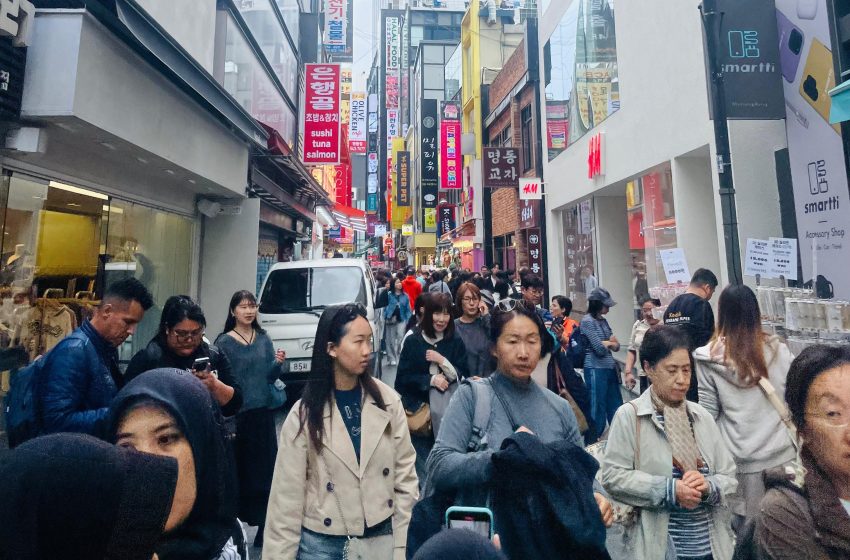
Myeongdong (Autumn, 2024)
Two waterfalls do not hear each other.
African proverb
By Benny Arnas
______________________
At first, Ted was a friendly young Korean man. Back when I was still in Lubuklinggau, the 28-year-old bachelor whose apartment we rented through Airbnb answered every question I threw at him in a warm, expressive tone. He didn’t just indulge my curiosity (which I later realized was closer to quiet skepticism) about the unit and its neighborhood, but also about everything—Seoul, Korea, life there in general. But that midnight, barely thirty minutes after China Southern CZ-388 landed at Incheon International Airport, Ted became someone else.
“I can speak English, but better we talk with Papago,” he said nervously, showing me the screen of his phone, already open to the translation app.
I couldn’t stop my eyes from widening. Ted must have expected that reaction, though he chose to ignore it. How could we meet, walk side by side, and yet have to communicate through text? It felt like living under the same roof but only speaking through WhatsApp messages. Absurd.
“Sorry,” he added, still tense, “I feel more comfortable this way.” The cold night air seemed to carry his words deeper into me, making them land harder than they should have.
I looked for my wife, hoping to share the strangeness of the moment. But the Indonesian language teacher was no longer beside us. About ten meters behind, she was busy tending to our children, who were pleading for snacks at a CU Mart.
Ted kept—still kept—that innocent expression before turning his gaze toward a row of electric poles stretching west. “These are the last words I’ll say out loud, Benn,” he said, nervous again. “Whether it’s because of language limitations or not, young Koreans are more expressive in writing. When they have to speak, they become someone else.”
“Someone else—or their real self?”
Ted said nothing. But I noticed the small muscle between his brows tighten and rise. Perhaps he was processing my question while also searching for a way out—an escape route from a writer’s instinct like mine. Still, it seemed clear he had no intention of retracting what he had just called his “last spoken words.”
“Which version of us is real?” I pressed. “The one typing on a phone, or the one speaking? The one hiding, or the one stepping into the crowd?” I genuinely wanted to hear his thoughts.
Ted remained silent. He chose silence deliberately. Only then did I notice how sharply his eyebrows angled downward, as if they could cut the air above his ears. It reminded me of portraits of East Asian figures from imperial times—or even Genghis Khan in his many depictions: expressions varied, but the brows always looked the same.
“The taxi will probably arrive in about fifteen minutes,” I said, glancing at the Kakao route on his phone. “So we still have time to talk. Or… we could continue this in the car…”
Ted shook his head. He typed on Papago. Behind his thick-framed glasses, he tried to hide his anxiety, but failed. WE WILL NOT BE IN THE SAME CAR. He pointed toward a line of vehicles across the parking lot after making sure I had read the sentence.
“So you don’t want us in your car?” I asked, even though I had no idea which one was his.
I DIDN’T KNOW YOU WERE ONLY BRINGING TWO SUITCASES.
I gave a faint, dry smile. “Didn’t I tell you we wouldn’t bring much? You said your apartment had a washer and dryer.”
Ted lowered his head and adjusted his glasses—though they hadn’t shifted at all. Awkward, but aware enough not to repeat the gesture of looking away.
“You can still cancel your taxi, right?”
He cleared his throat while typing. I could hear his breathing—quick, uneven. The nervousness clung to him. It was intense. I felt a flicker of sympathy. NO. YOUR TAXI WILL FOLLOW MY SEDAN.
“Alright,” I exhaled. I didn’t want to stretch this stiff exchange any further.
But Ted wasn’t what I had assumed. He wasn’t as simple as he seemed. He pushed back. He showed me his Papago screen again. WHICH ONE IS REALLY YOU—WHEN YOU WRITE YOUR NOVELS OR WHEN YOU LIVE AMONG PEOPLE?
Now it was my turn to fall silent. His counterstrike caught me off guard. He had turned my own words into a boomerang.
OR HOW IMPORTANT IS IT TO BE YOURSELF? WHAT IS THE PARAMETER THAT MAKES YOU SURE THIS IS YOURSELF? WHAT IS “YOURSELF,” ANYWAY?
“Ted?”
NOT EVERYONE IS GRATEFUL TO BE BORN, BENN.
“And you’re one of them?”
I DON’T WANT TO ANSWER THAT.
“Hmm. Alright. Then what?”
THAT’S WHY WE HAVE THE RIGHT TO CHOOSE WHAT MAKES LIFE LESS PAINFUL.
I don’t know—I could see something raw in his words. Something open, damp, almost festering. It must have hurt.
I was reminded of Hanan Parvez, a psychologist who wrote about how hatred often functions as a way to avoid pain. When we feel hatred, he argued, we are actually distancing ourselves from disappointment.
CALM DOWN. I JUST DON’T WANT TO TALK. I DON’T HATE YOU, BENN.
It was a beautiful statement. We—including me, before reading that line—are so quick to label behavior like Ted’s as personal hostility, when in fact it may simply be a response to past wounds.
FOR ME, SPEAKING IS A SERIOUS MATTER. I HAVE FRIENDS WHO ARE THE SAME. MORE THAN TWELVE OF THEM. AND PROBABLY MANY MORE OUTSIDE OUR CIRCLE. WE ONLY DO IT WHEN WE WANT TO.
“Alright, Ted,” I said, giving in a little. “I didn’t mean to interfere with your choice.”
Ted smiled—for the first time. DON’T BE TOO SERIOUS. IF THIS IS YOUR FIRST TIME IN KOREA, AT LEAST THIS MEETING—AND EVERYTHING WE’VE TALKED ABOUT—CAN PREPARE YOU SO YOU WON’T BE TOO SURPRISED. Then he laughed, silently.
Our taxi arrived.
An hour and a half later, when we reached his apartment unit on the eighth floor in Guro District, Ted sent a welcome message—this time in lively language, complete with expressive emojis, as if he were the most engaging person to talk to.
Ah, I was reminded of a moment involving Charlie Kaufman, when Nicolas Cage asked him whether it was possible to create stories without conflict—because, well, uneventful calmness is also part of real life. I found Cage’s question (or statement) interesting. At the very least, it’s often used by some writers to defend weak storytelling.
Kaufman stood up to respond. After stating—emotionally—that no one wants to experience a story without conflict, he slipped in an expletive while repeating Cage’s phrase the real world. “The real f**k*** world?” he echoed mockingly.
The man, already in his sixties, wasn’t just emotional—he was offended, baffled that Cage could claim that flatness (or mere “everything-is-fine-ness”) reflects life. “Theft happens every day, people fall in love again and again even though they know rejection hurts, betrayal happens between close friends or even siblings, genocide and war steal happiness at every turn… and in the middle of all that, you want to tell a story about things being fine because that’s supposed to represent real life?!”
Kaufman was urging us to stay sensitive. To feel uneasy is a sign that our senses are still alive. I began to see Ted from outside the box I had placed him in. He had pulled the curtain back just slightly, letting me glimpse his private world—and that supposedly “uneventful” world shattered instantly. Warmth and cheer gave way to distrust and a kind of unraveling impossibility. Ted’s world, through Kaufman’s lens, was full of tension—landmines of surprise that could detonate at any moment.
That is why good writers understand that complex characterization is essential to a compelling story. In Parvez’s terms, Ted represents layers of anxiety that, at an acute level, transform into a kind of personal comfort. And when he spoke about his friends who share similar tendencies—perhaps even the same “character”—that comfort becomes intersubjective. Within their circle, it turns into a normalized state. This is not just a turbulent world, but one layered with wounds and fractures. And for a writer or filmmaker, encountering such human irregularities is strangely exhilarating. A bright, undeniable irony—born from introversion, from the inner worlds of those who withdraw from the crowd.
Of course, I didn’t have the capacity to dissect all this—at least not until I met Ann Hyun-ill, a doctoral candidate in psychology at Sungkyunkwan University who startled me the moment she mentioned her age. “I’ll turn twenty-five this December.” Hyunn had first noticed the interaction between me and our youngest daughter in front of a shelf of children’s picture books written in Hangul at the ever-busy Starfield Library in Gangnam on a crowded Monday. “You can’t read Hangul?” she asked, just as I realized we were being closely observed by someone whose face reminded me of the Chinese badminton legend Ye Zhaoying.
After my answer drew a wide smile from her, we introduced ourselves. “Your daughter…”
“Maura,” I said.
“Oh, that’s a beautiful name.”
I smiled at Maura, who was still flipping through a book filled with frogs dressed like royalty—though what story they told, I couldn’t quite tell.
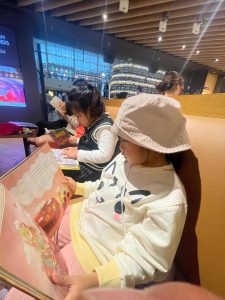
“Maura is very visual. It’s not easy for children her age—especially those already fluent in Latin script—to focus on extracting a story from images when the accompanying text is in a language completely foreign to them.”
“Well,” I said, “aside from forcing ourselves to make sense of whatever we can, do we really have any other choice in a library like this?”
Hyunn laughed. Of course—Starfield Library’s collection is almost entirely in Hangul. “Writing in Hangul has become a kind of stance for writers in this country,” she said after we found an empty bench beside a shelf of children’s novels, also in Hangul. “You can’t preserve a script or a local language just by teaching it in school—especially when it’s tucked into a minor subject that looks important at first glance but ends up being little more than an accessory.”
I was suddenly reminded of regional languages and scripts in Indonesia, taught as local content subjects in places like Lubuklinggau.
“If once people step outside school—or any learning space—and those languages are drowned out by the dominance of the Latin script, everything will simply evaporate. It’s pointless.”
I looked around, recalling how thoroughly Hangul dominated textual literacy in Korea. Everywhere: road signs, subway information, product labels—everything appeared in that script of 14 consonants and 10 vowels. At that point, Korea hardly needed local-content classes in schools or even universities—life itself had become an open book with endless pages. “Writing in local scripts and languages, almost without realizing it, preserves the authenticity of voice, emotion, and the textures of locality that a writer carries.”
“Is that part of what led Han Kang to win the Nobel Prize a few days ago?”
“Han Kang is a genius—with or without recognition from the Swedish Academy,” Hyunn said with a smile. “But like many Korean writers, she’s also a passenger in the long train of those preserving Hangul.”
Just another passenger among many? I nodded slowly.
“When we stop speaking it, stop writing it, stop spreading it across the corners of our cities, we unintentionally turn it into an introvert—isolated, pushed into a dry corner. Let alone thriving, it can barely survive.”
I was struck by the metaphor. “So that’s how simply you see introversion?”
Hyunn brushed aside her bangs—nearly covering her eyes—with her right hand, where a ruby ring glinted on her middle finger (I chose not to ask about it). “Introversion is a complex inner condition—a response shaped by internal stimuli. Remember that,” she emphasized. “Complex. Intricate. Not something broad and flat.”
I nodded, handing Maura a new book as I realized she had reached the final page of her royal frog story.
“This condition makes introverts less dependent on external environments to function at their best. External stimuli are like passing gusts of wind brushing through tall grass—present, yet negligible. So because they don’t rely on the outside world, constant external interaction—like talking for hours—doesn’t normalize them. It actually makes them lose themselves.”
“So introverts are always restless?”
Hyunn nodded. She suggested we find a café, but I couldn’t accept—besides looking after Maura, I was waiting for my wife and our other children, who were still wandering through the library. “Yes, introverts tend to think deeply about many things. So instead of dealing with the outside world, just debating with themselves is already exhausting. They recharge in solitude. The more time they spend alone, the more refreshed they feel.”
I kept nodding, mentally taking notes—the very notes you’re now reading.
“Introverts don’t usually hate people. They just dislike talking. Conversations can overwhelm them, even make them feel like they’re losing control. To outsiders, that looks like a ‘problem.’ They might be perfectly fine texting, because it allows them to pause, rethink, and process more deeply mid-conversation. But because of that habit, they often overthink and can seem panicky when responding—even to something as light as a conversation about a bad dream. That’s why small talk becomes difficult. They tend to be economical with words, yet getting straight to the point isn’t easy either.”
I wanted to tell her about my encounter with Ted, but interrupting her while she was in full flow felt like a waste. “Introverts, once they find their path, can become very dangerous!” she laughed. “Let me explain.” She seemed eager to make sure I didn’t misunderstand the word dangerous. “There’s an African proverb—two waterfalls don’t hear each other. The focus of an introvert can be so intense that they could ignore a meteor crashing into their city. That’s how the world ends up with people like Albert Einstein, Carl Jung—or even Michael Jordan!”
I hadn’t even known the basketball legend was an introvert.
“Are many Koreans introverts?”
Hyunn shook her head, then nodded uncertainly. “Maybe. But if we’re talking about feeling isolated—I’d bet yes.”
“Are introverts more prone to depression?”
“Depression grows when life—with all its problems—turns into a tree with tangled branches: complicated and heavy. When problems can’t be unraveled, the mind instinctively redirects all its energy toward them. That’s why people under serious pressure often withdraw socially—to reflect, to sink into a contemplative mode. Reflection brings us closer to solutions. So when people facing heavy problems choose silence and solitude, it doesn’t mean they’re moving toward self-destruction. They’re not trying to hurt themselves. They’re releasing negative energy in ways that may look abnormal to outsiders.”
“So the suffering of depression resembles introversion—both judged or alienated by those who believe that living in crowds is the ‘right’ way to live?”
“A very thin line,” Hyunn said with a smile—one that only sparked more questions in my mind. Unfortunately, she had to leave. “No,” she said, shaking her head when I asked for her number or email. “Knowing when to stop—especially in moments of intensity—isn’t easy, even in conversation. Some people call it foolish. But if you can hold yourself back, the effect is powerful.” Then she walked away. I stood there, frozen—perhaps I would have remained that way longer if Maura hadn’t told me she spotted her mother and siblings approaching from the escalator at the center of the library.
***
In the days that followed, communication between Ted and me settled into a kind of “normal.” Ted with his Papago, and I with my spoken English. Ted always dodged—refused to answer—whenever I tried, even implicitly, to probe the anxiety he carried. Introversion and alienation—ah, the line between them is razor-thin. If only I had Hyunn’s contact, there would be so much I’d want to discuss. Perhaps I’d even entertain the idea that holding back curiosity has its own thrill, though I doubt I’d sustain it for long.
“Back in elementary school—maybe around fourth grade, when math started to feel like a maze with no exit—all the way through college, I had what you’d call math anxiety,” I said unprompted on our third night in Seoul, when Ted came by to drop off detergent. THIS SHOULD HAVE BEEN PROVIDED IN YOUR UNIT. I’M SORRY, read Papago on the screen in his right hand.
Yes, Ted was consistent. Unwavering. He refused my invitation to step inside for tea or coffee. Still, I kept talking. “That’s also what eventually led me to feel at home in literature. Even though I’m not entirely sure, I believe that the string of failures I went through—at least in trying to enjoy being a student in classrooms and labs, in a Plant Breeding program steeped in science—and the discomfort I felt working as an employee, all of that opened a door I hadn’t seen before: writing stories.”
MY QUESTION REMAINS THE SAME, Papago continued typing. IT IS YOUR QUESTION FROM YESTERDAY, RETURNED TO YOU. WHICH ONE IS THE REAL YOU: THE ONE WHO WRITES STORIES OR THE ONE WHO DOESN’T?
I fell silent.
I WILL “LISTEN,” he typed. YOU HAVE PLENTY OF TIME IF YOU WANT TO LECTURE, followed by a laughing emoji.
I was still thinking.
YOU ARE COMFORTABLE BEING A WRITER EVEN IF YOU WEREN’T BORN FOR IT. YOU CAN CHOOSE, YOU CAN TURN, FOR REASONS ONLY YOU UNDERSTAND—AND YOU DON’T HAVE TO SHARE THEM WITH ANYONE IF YOU DON’T WANT TO.
I knew what he was doing—shielding himself by pulling me into his narrative. At this point, I had to be careful. Ted was, or at least was trying to be, a manipulator.
I was in the middle of typing a reply when he mentioned he had a twin brother who lived and worked in Myeongdong. OUR CHARACTERS ARE COMPLETE OPPOSITES. BUT IN HOW WE SEE LIFE, I THINK WE’RE THE SAME. AT LEAST THAT’S THE THREAD—THE KIND OF DNA TWINS SHARE.
What a coincidence. Before noon, we were planning to visit that very district—the largest street shopping hub in Seoul.
***
We arrived at Myeongdong Station, exiting through Gate 7. After passing a large snack shop wrapped in bright yellow packaging, we merged into the current of people from every background already flooding the streets.
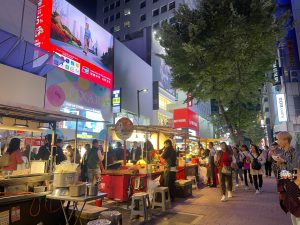
The kids were mesmerized by the spread of Korean street food—things they had only seen on TV or tasted in modified versions back home in malls and night markets in Lubuklinggau. After indulging their requests and satisfying their curiosity, two hours later we reached one end of Myeongdong’s branching streets.
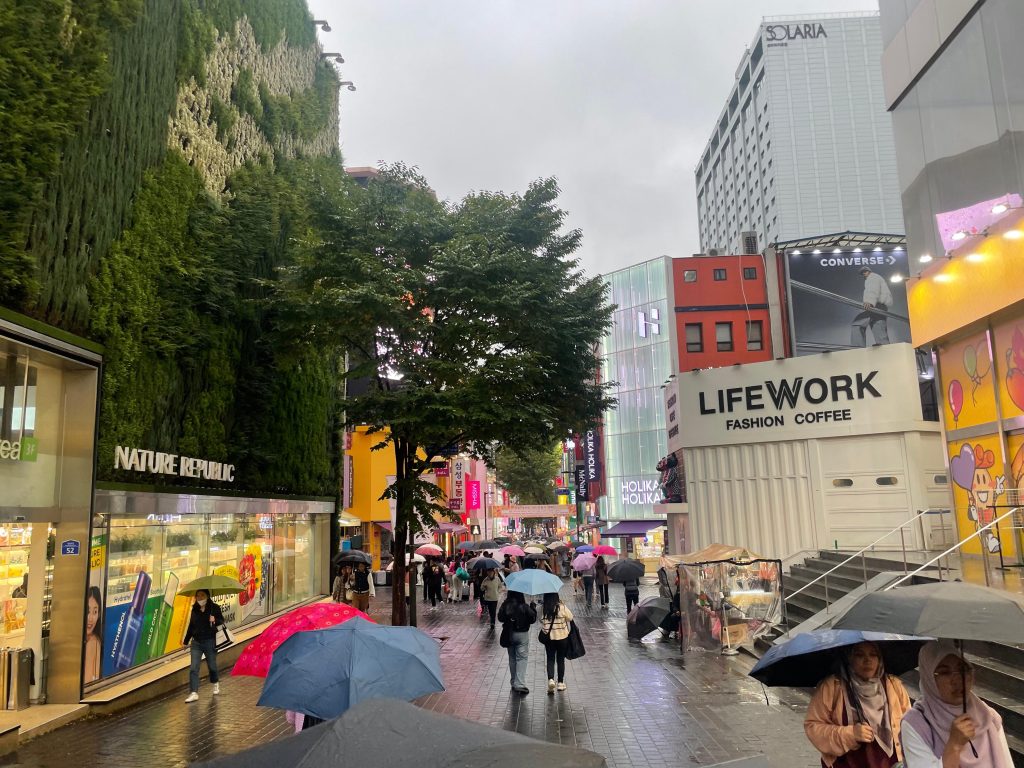
Not far from Exit 17, which led toward City Hall Station, my wife and children asked to take a break. Autumn had begun to soften the heat, though the sun still struggled to slip free from drifting clouds.
I left them resting under the overhang of a shopping complex and went to meet Kris—the Latinized name of Ted’s twin—who had just closed his stall early after selling out of odeng and tteokbokki.
“Ted told me about you,” he said, his face lit up. “I can’t leave yet—my friend’s tanghulu cart is still loaded,” he added, pointing at a man our age dipping skewers of grapes, strawberries, and oranges into molten sugar. “Too bad you’re Muslim,” he said, pouring liquor into a small glass beside the cart.
Ah.
“But honestly, drinking this early isn’t that great,” he went on. “But I feel like it, so to hell with manners.” He laughed at his own words and actions. “Still, nothing beats a drink after 9 p.m.”
If Kris meant to shake my resolve, he miscalculated.
“Coming home tipsy, collapsing onto the bed, drifting off without a care. Waking up at ten. After reheated pork from the microwave, a cup of black coffee, then prepping the stall while whistling a favorite tune… and pushing the cart back onto these streets by eleven.”
“So that’s life, to you?” I asked, glad he instinctively knew where this conversation could go.
“Do you know our ancestors?”
“The Neolithic people?”
He let out a small laugh—half amused, half dismissive—waiting for me to refine my guess.
“Well, like Japan and China, you must share common roots—three to three-and-a-half thousand years ago, during the Shang Dynasty. Care to argue?”
“Too far back. Think closer. Say, after the twelfth century.”
“After Rome, Persia, and the Islamic world had aged into empires leaning on canes—no longer feared even by children?”
Thankfully, that image made him laugh.
“And then came Mongolia—an anomaly that bent history this way.”
“You’re claiming Mongolian blood?” I suddenly pictured Genghis Khan’s face—and compared it to Kris. The same brows. The same trace of arrogance.
“If your ancestor is Genghis Khan,” I said with a faint smile, trying not to sound cynical, “that’s quite a contrast with how I imagine Mongolian men.” I failed to hold back.
“Oh yeah?” Kris began tidying his pots and utensils. “What kind of contrast?”
I cleared my throat, quietly assembling words to win the argument. But he took it differently. “Go on,” he said, tying up a trash bag with a thick rubber band from the cart’s drawer. “I’m used to multitasking.”
“To me, Mongolian men are defined by two traits: brutality and openness. Three, if those two merge.”
Kris smiled. “Cold-blooded.”
I paused. I recalled lists of psychopathic traits. To those who don’t understand, calling someone “cold-blooded” sounds like a moral judgment. But for them, it may simply be a reaction to how unfairly the world reads those who are different.
“Ted and I have three older siblings and two younger ones. Two of our older siblings were jailed for abandoning several dogs on an island while the wealthy owner was away on vacation. Yes, they abandoned them—deliberately. I suspect there was resentment behind it, though nothing came out in court. Some of the dogs were traumatized, and the owner pressed charges. The pet care company they worked for panicked and tried to wash their hands of it. As for our younger siblings—they were different. Hikikomori. I think Ted is heading that way too. It makes me sad, but what can I do?”
“What about your younger siblings now?”
“One ate so many persimmons his intestines ruptured. The other fell from the seventeenth floor while practicing parkour.”
A dull ache crept through me.
“They both died.”
Because he said it so flatly, I hesitated to offer condolences.
“No need to feel bad. They didn’t inherit Tae Mu-jin’s blood.”
Oh.
“That warrior’s blood runs only in me and my father. Not the others.”
Tae Mu-jin—better known as Genghis Khan—was not only responsible for around forty million deaths, nearly twenty percent of the world’s population at the time, but is also believed to have sixteen million descendants. Eight percent of Asian men are said to carry his lineage.
The Mongols—once dismissed as rough tribes in northern China—were never taken seriously. Nomadic, unruly, pitching tents across the steppe; looting when opportunity arose and spending it on fleeting pleasures; and when boredom struck, turning to civil conflict as if it were a pastime. Until one abandoned baby boy—cast away by a general under orders from a grandfather haunted by a dream that this child would one day seize his power—grew into something else.
“I once took revenge on a neighbor who insulted our family’s honor. We still lived behind Insadong then. Our father was an unusual man—he forged swords and shields. He refused mass production. Said we wouldn’t manage it anyway, and he didn’t trust outsiders to help. ‘They don’t carry Mongolian blood. Loyalty isn’t guaranteed. Mongolians may be open, but I won’t take that risk,’ he used to say,” Kris told me, settling beside me with a glass of liquor in hand. “Want to know how I got my revenge?”
I chose not to answer, worried I might interrupt the strange comfort he had found in telling the story.
“I was twelve. I secretly broke into my father’s savings. I knew that neighbor’s routine—buying sweet potatoes and rice every morning before dawn. So for days, I bought up every supply those shops had before he could get there. By the fourth day, I was buying anything I could find before sunrise. Do you know what happened on the twelfth day?”
I shuddered just imagining it.
That neighbor of ours—his entire family—was found weak and barely conscious. My father was the first to open the food reserves I had hidden in the underground storage and bring them to their house. I was furious. He must have known. “Relax,” Father said with a sly grin. “I’ve locked all the doors from the outside.” We smiled at each other. Two days later, that family came and bowed deeply—far too long—in front of my parents. I wanted to ask Father so many things, but held back. Especially when he went on to recount the glory of Mongolia conquering the Jin, Song, and Tangut dynasties—until China fell and Beijing became the Mongol capital at the time.
Just imagining how “the Mongols pitched their tents beyond the borders of those three dynasties, cutting off supply lines so completely that people were left with only two choices: starve or turn to cannibalism” was enough to make my skin crawl. And now—hearing that Kris’s family had applied a similar tactic to their neighbor—was even more chilling.
“So you chose to run a stall in Myeongdong?” I asked, hoping the subject might steer us away from that horror.
“The youngest child in that family is still alive. To this day. We’re in a cold war. He’s tried several times to harm me—once he wrecked my cart in the middle of the night. He forgets—Mongols are formidable. We could ride horses without reins. Sword in the right hand, shield in the left.”
“Do people understand the ‘Mongolism’ in you?”
“Like you said earlier, Benn,” he said, draining his drink, “here I become someone open—not savage.”
That unsettled me even more. To be honest, when I first learned that the Mongol Empire—perhaps the only empire of its kind—did not impose Shamanism, the belief in Tengri as the supreme spirit, on conquered peoples, I admired their pluralism. But to see it resurface—distorted, sharpened—in a modern context made me uneasy. “You know that during Mongolia’s golden age, it was common to see followers of Shamanism, Islam, Christianity, and Buddhism walking side by side in public spaces—each visibly themselves?”
Kris nodded. “I even think Koreans who still believe in spirits carry traces of that Shamanistic past.”
“Hmm. Are you a shamanist?”
Kris smiled. “I became a Christian at a friend’s wedding.” Then he laughed. “So in Myeongdong, I’m a pluralist Mongol.”
For a Muslim like me, Mongolian pluralism isn’t entirely comforting—especially knowing that Muslim soldiers were part of Hulagu Khan’s army when Baghdad fell in 1258.
“On the streets of Myeongdong, people see us as vendors selling food. But not really. When they crave odeng or tteokbokki on a cold day, they have no real choice but to buy from us—unless they’re willing to walk two kilometers to find another stall,” he said, laughing again. “This ring of street food stalls isn’t so different from the Mongol siege lines around the Tangut.” His laughter grew louder. “That’s why bright afternoons in Myeongdong matter—we live off crowds. Especially in spring and autumn. Those seasons make us brighter, our smiles wider, our pockets heavier. Customers are happy—and we don’t feel like servants.”
Kris was right. At least, it showed in something as simple as waste management. In Korea, each vendor is responsible for the trash their customers produce. Customers have no choice but to return cups, plates, skewers, or chopsticks—because there are no public trash bins in crowded places like Myeongdong, and littering only creates trouble for themselves. From my travels, Korea stands out as a country that successfully compels everyone—locals and visitors alike—to follow its environmental order. Myeongdong convinced me that more trash bins are not the answer. Rules, enforcement, and shared social pressure must work together. Once one piece breaks, the whole system unravels. That’s what I’ve seen in places like Indonesia and India, where cleanliness isn’t just an issue—it becomes a kind of normalized chaos.
Dusk was settling in when a fresh batch of raw odeng and tteokbokki arrived for him to cook in the pan at the center of his cart. “Second round,” he said. “Nighttime in Myeongdong—especially under a clear sky like this—is everything for us.”
I understood. It was time for me to leave.
***
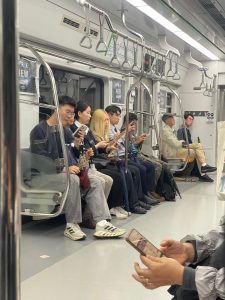
On the metro back to Guro, I met En-chi—a girl who had overheard my wife and me debating, in English, which subway line to take. She stepped in, almost instinctively, to guide us.
Again, a mistake that made life feel alive. In a normal moment, my wife and I would have spoken calmly. Instead, we argued in public—and that misstep gave us a quiet hero, someone who not only pointed us in the right direction but also showed us the art of letting things pass. Anger, raised voices—these imperfections sometimes lead to unexpected clarity.
En-chi said we were heading in the same direction. “But I’ll get off at Sidorim, a few stops before you,” she added. She didn’t smile, but there was a quiet warmth in her face—she looked to be in her early twenties.
“Are you a student, working, or both?”
She said nothing. No nod, no shake of the head. Then she typed on her phone. Papago again. I WILL HELP YOU GET TO THE RIGHT STATION. THAT’S ALL.
A precise statement. Intentional kindness—that’s what I’d once heard it called in a psychology podcast. People who live by it do only the good they choose to do, and they take responsibility for that alone. They don’t volunteer for kindness they didn’t intend. They act not out of obligation, nor for approval, but simply because they decide to.
I saw the same kind of intentionality in Seoul itself—in its clean, free public restrooms. A stark contrast to parts of Europe, or even some paid yet poorly maintained public toilets back home in Indonesia. So when you step into a pharmacy restroom that’s spotless and free, it doesn’t mean the owner will greet you warmly or expect you to buy something. We experienced that on our second visit to Myeongdong. I entered a pharmacy, my white T-shirt damp with rain, and asked in English about ointment for Maura’s skin, which reacted badly to the cold. The elderly man behind the counter responded sharply—in Korean. I turned to Papago to clarify. He instructed a woman—his wife, perhaps, or an employee—who seemed friendlier, to fetch a product. After confirming it was an ointment, not pills or syrup, I paid 7,000 won. I regretted saying kamsahamnida when he didn’t respond at all.
On the short walk from Guro Station to our apartment—just 300 meters—after ordering hot americanos at a large café called Coffee Roasting & Brunch, the rain fell lightly. We took shelter at an odeng stall because my wife and children wanted to enjoy what they called “boiled pempek”—savory fish cakes in broth. We liked stopping there—not only because it was far cheaper than in Myeongdong (even though the portions there were larger!), but because the elderly woman who ran the stall was incredibly kind. She seemed to adore children. “Yeppo,” she said again and again, looking at our three daughters as they ate with delight. To her, every little girl wasn’t just cute—they were yeppo, beautiful.
That odeng seller near Guro Station felt like an anomaly in the Korea we experienced during that week in Seoul—though part of me wondered if she, too, had another face, or if she was simply practicing that same intentional kindness. She praised because she wanted to—not because she had to. Ah.
Unlike Kris or the vendors in Myeongdong, the woman—whose name we never managed to ask—seemed to believe that overcast days were everything. For her, life was about people who came and bought something, not about bright sunshine or blooming spring.
“Every time she sees little children, she’s reminded of her grandchildren in Busan,” said another woman who had left a tray of cinnamon sago cakes at the odeng stall. She welcomed the Hangul text I showed her—generated through Papago—with ease. From her, we also learned that the odeng seller’s eyesight was failing, which explained why she often seemed out of sync when I tried to communicate using my translated phrases. “To her, a bright day means everything.”
BUT RIGHT NOW, IT’S RAINING.
The woman selling the cinnamon cakes smiled and spoke into my Papago speaker. “Those who wait for sunshine are always disappointed when it rains. They forget—rice that’s washed too long, or never cooked at all, will just turn into something useless,” she said, laughing again.
Suddenly, I remembered something Ethile once told me, catching my awe at the beauty of Slovenian girls—just after my mind had been clouded by the charm of Hallstatt in early spring. “God must have created them on a bright Sunday,” said my travel facilitator in Austria five years ago, with unmistakable pride. I knew she carried Aryan blood—but when it came to Slovenian girls, she had every reason to boast.
Perhaps Myeongdong was created on a day like that too—a holiday, bright and full of light. But only the place, not the people.
WHAT ABOUT KRIS? INTERESTING? Ted’s message appeared on my still-locked phone screen. WE’RE LIKE JUNG AND FREUD. MAYBE NOT BOTH MAD, BUT BOTH AVID READERS.
Carl Jung had once been Sigmund Freud’s loyal student—until the mentor distanced himself after Jung sent him a bundle of writings on schizophrenia. Some called Jung a traitor, just as others labeled Freud stubborn. As an introverted thinker, Jung disliked publicity—except when it came to his research, which both reinforced and challenged many of Freud’s ideas.
Outside, the rain poured heavily. No wonder Ted—the “Jung” in this pairing—reached out without hesitation.(*)
Guro–Lubuklinggau, October 2024
